





Artificial intelligence is moving beyond chatbots and simple content generation. In 2026, AI agents are becoming capable of handling multi-step tasks, interacting with software, analyzing information, and completing workflows with limited human intervention.
Unlike traditional AI tools that mainly respond to instructions, autonomous AI agents can plan actions and work toward specific objectives. This shift is changing how businesses manage operations, customer relationships, software development, and digital marketing.
At WorldInfoToday, we explore how agentic AI is transforming modern workplaces and what this technology means for the future of business.
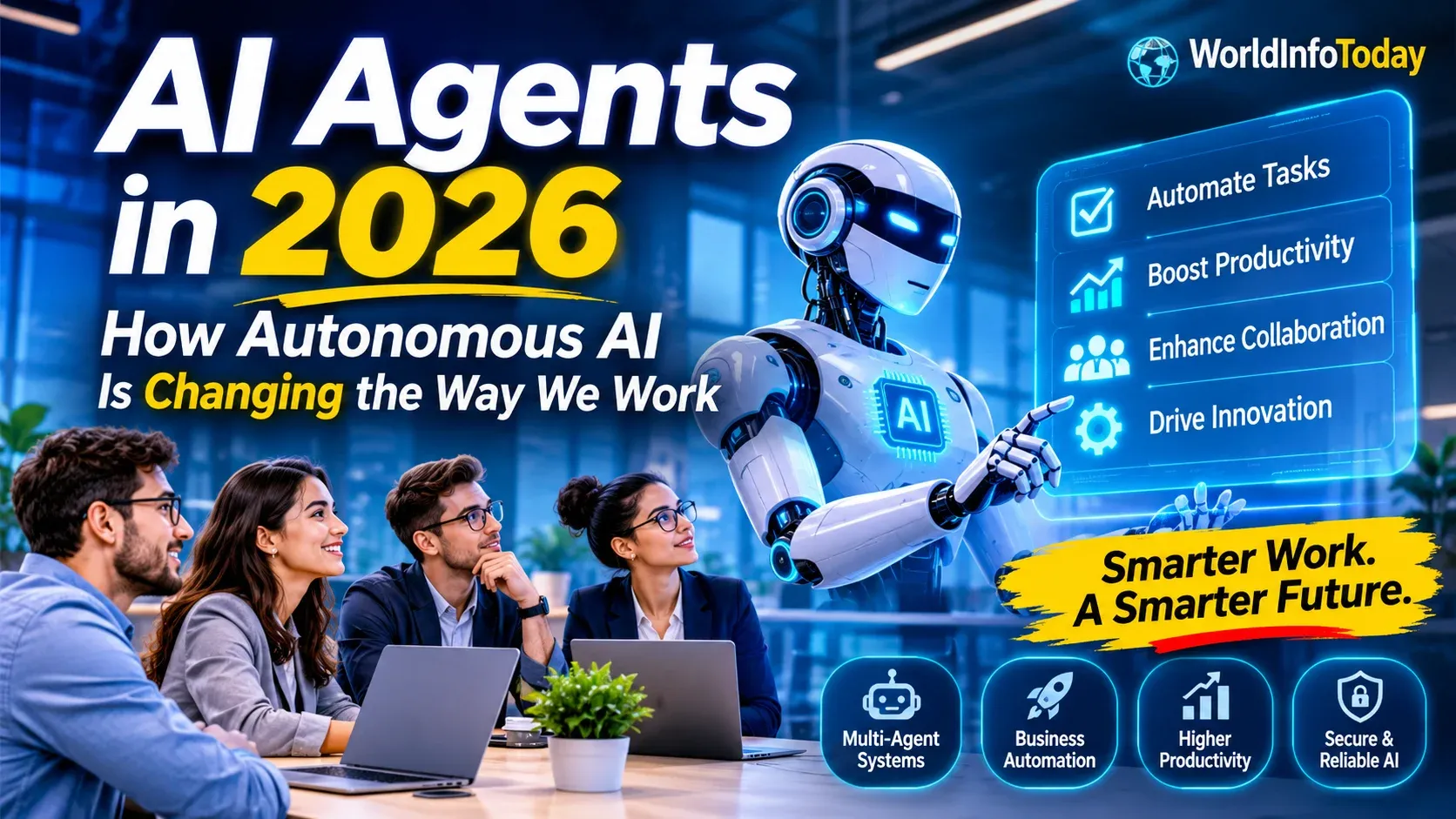
What Are AI Agents and How Do They Work?
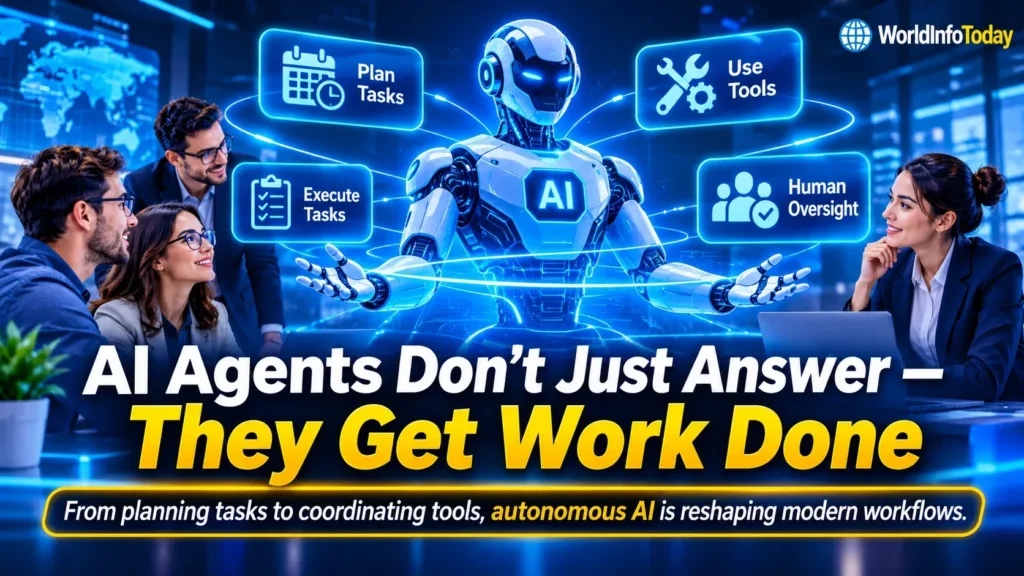
AI agents are intelligent software systems that use artificial intelligence to understand objectives, make decisions, and perform tasks through connected tools and applications.
Most modern AI agents combine large language models (LLMs), external APIs, memory, and task-planning capabilities.
For example, a business research agent can collect market information, compare competitors, organize findings, and prepare a report without requiring separate instructions for every step.
The important development is not simply smarter AI responses but the ability to turn instructions into completed actions.
How AI Agents Are Changing Business Operations in 2026
AI agents are creating new opportunities across different industries.
1. Business Process Automation
Companies are using intelligent agents to manage repetitive administrative tasks, organize information, and coordinate operations between different software platforms.
2. Customer Service and Support
AI-powered customer service agents can understand customer requests, retrieve relevant information, update records, and handle routine support operations.
3. Digital Marketing and SEO
Marketing agents can assist with keyword research, competitor analysis, content planning, campaign reporting, and website performance monitoring.
4. Software Development
Coding agents can help developers analyze code, identify errors, generate tests, and support software development workflows.
5. Financial and Administrative Management
AI agents can assist with invoice processing, expense classification, document verification, and financial reporting, with human approval for sensitive decisions.
Multi-Agent Systems: The Next Development in Autonomous AI
Multi-agent systems use multiple specialized AI agents to complete a shared objective.
Instead of assigning an entire project to one AI system, businesses can distribute responsibilities between research, analysis, content creation, and quality-control agents.
For example, an automated marketing workflow could use one agent to research competitors, another to analyze SEO opportunities, and a third to prepare content recommendations.
This coordinated approach can improve workflow organization, although it also requires reliable communication, monitoring, and security controls.
AI Agents vs. Traditional Automation: What Is the Difference?
Traditional automation follows predefined rules, while AI agents can interpret objectives and adapt their actions within permitted boundaries.
| Traditional Automation | AI Agents |
|---|---|
| Follows predefined rules | Works toward defined goals |
| Handles predictable tasks | Handles more flexible workflows |
| Limited decision-making | Context-based decisions |
| Fixed process structure | Can adjust task sequences |
| Trigger-based execution | Can coordinate multiple actions |
Both technologies remain useful, and combining them can create more effective business processes.
Challenges of Using Autonomous AI
Despite their potential, AI agents introduce important challenges:
- Data security: Connected agents may access sensitive business information.
- Incorrect decisions: AI-generated outputs can contain errors.
- Limited accountability: Businesses need clear responsibility for agent actions.
- Operational costs: Development, integration, and monitoring require resources.
- Human oversight: Important financial, legal, and business decisions need appropriate supervision.
Successful implementation depends on controlled permissions, reliable data, and continuous performance evaluation.
What Does the Future of AI Agents Look Like?
The future of autonomous AI will depend on how effectively businesses integrate agents into their existing operations.
Research from McKinsey’s 2026 State of AI survey found that 40% of respondents from organizations with annual revenues above $1 billion reported scaling AI agents in at least one business function, compared with 27% in the previous year.
This suggests that enterprise adoption is progressing, although implementation maturity varies between organizations.
Over time, AI agents may become standard components of business software, research platforms, and workplace productivity systems.
The biggest opportunity will not necessarily come from replacing employees. It will come from allowing people to delegate routine execution while focusing on strategy, creativity, and decisions that require human judgment.
Final Thoughts
AI agents are changing artificial intelligence from a technology that primarily generates information into one that can actively support business operations.
From marketing and customer service to software development and administration, autonomous AI is creating new ways to organize work.
However, businesses must balance automation with security, accuracy, and human accountability. Organizations that build reliable workflows around AI agents will be better positioned to benefit from this technological shift.
WorldInfoToday will continue exploring emerging AI technologies and their impact on businesses, professionals, and everyday life.
Frequently Asked Questions
1. What are AI agents?
AI agents are intelligent software systems that understand objectives, make decisions, use external tools, and perform tasks with varying levels of autonomy.
2. How are AI agents different from chatbots?
Chatbots primarily answer questions, while AI agents can plan and execute multi-step tasks using connected applications and tools.
3. How are businesses using AI agents in 2026?
Businesses use AI agents for customer support, marketing, SEO research, software development, financial administration, and workflow automation.
4. How to Build an AI Agent?
To build an AI agent, choose an AI model, define its objective, connect relevant tools or APIs, configure memory and instructions, and test its performance. Add security controls and human supervision before deployment.
5. How to Improve AI Agent Performance in Sovereign Multi-Agent Systems?
Improve AI agent performance in sovereign multi-agent systems by defining clear agent responsibilities, optimizing communication protocols, using reliable shared knowledge systems, reducing unnecessary task duplication, and implementing continuous performance monitoring.
